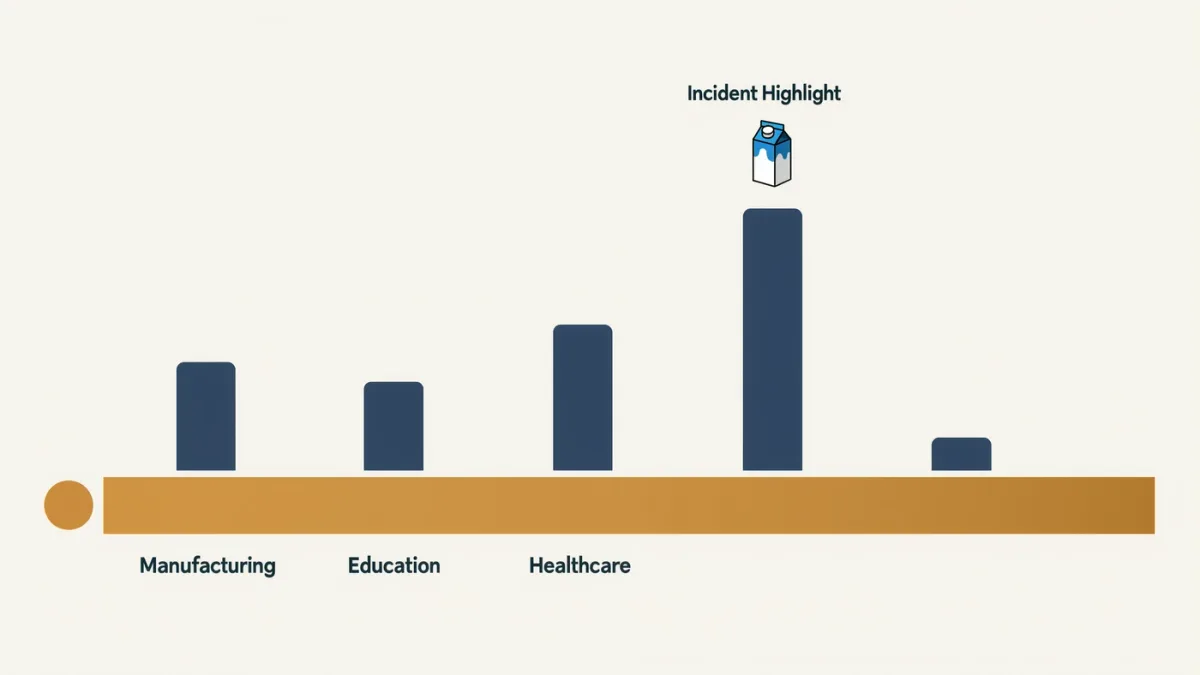
Coca-Cola confirmed that production at its Fairlife dairy operation was suspended following a ransomware attack, with industry tracking of July 2026 incidents placing the disruption in mid-July — reported July 16 by CM Alliance's monthly cyber-incident catalog. The incident is the latest in the manufacturing sector's running pattern: ransomware crews target producers precisely because downtime is intolerable, converting operational technology into leverage. Fairlife — the ultra-filtered milk and protein-shake brand Coca-Cola acquired fully in 2020 — resumed work as the incident response proceeded; details on the strain involved and any data theft remained limited at the time.
What is known?
Per the company's acknowledgment and monthly incident tracking: a ransomware attack at the Fairlife operation with production suspended during response, dated to July 2026. As is standard early in such incidents, the ransomware family, the intrusion vector, and whether data was exfiltrated for double extortion were not publicly established in the initial coverage. Manufacturing intrusions of this shape typically enter through IT-side channels — phished credentials, exposed remote access, an unpatched VPN — and then affect production either by encrypting shared systems or by deliberate shutdown during containment.
Why is manufacturing a favorite target?
Economics. A factory that stops loses money by the hour and often cannot easily fail over — there is no cloud instance to spin up for a bottling line. That makes manufacturers unusually motivated to restore quickly, which ransomware crews price into their demands. Sector-level reporting through the mid-2020s has consistently shown manufacturing as the most-attacked industry in ransomware statistics, and food production specifically — with perishable inventory and thin margins — sits at the sharp end: the 2021 JBS Foods attack that shut down North American meat plants remains the sector's defining case, resolved with an $11 million ransom payment the company publicly acknowledged.
What should other producers take from it?
- Segment the plant floor. OT networks — the systems running production — belong on separate segments from corporate IT, with controlled, monitored crossings. Most sector incidents cross exactly where that separation is missing.
- Harden remote access. MFA on every remote path, vendor portals included; the engineering workstation reachable by a reused password is the sector's standard entry wound.
- Rehearse the manual operation: plants that can run degraded and paper-based for a shift lose less to extortion leverage — an incident-response plan that includes operations, not just IT.
- Backup what runs the plant, with offline copies of the configurations and programs that machines need to restart — ransomware's first move is deleting reachable backups.
What about consumers?
Limited implications: product shortages of specific Fairlife lines are possible during recovery, and any later-confirmed data theft would bring its own notification process. The recurring consumer-facing note for brand-substitution scams — fake "compensation" or "product recall" phishing riding on incident news — applies: treat such emails as suspect and check the company's official channels directly.
The mid-2026 picture across sectors — payments processors, education platforms, regulators' associations, and now a dairy floor — is one pattern with different victims: extortion economics seeking whoever cannot tolerate stopping. The defense that keeps pace is the unglamorous one this incident will again prove: segmentation, hardened access, tested recovery.