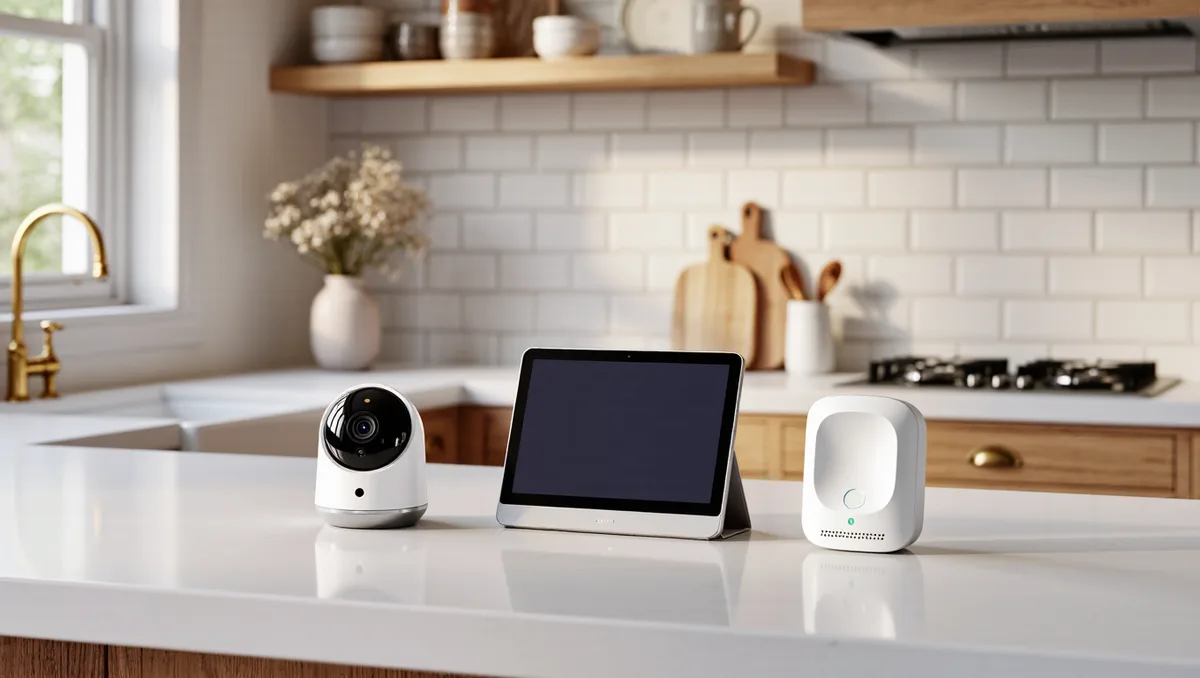
What should you actually pay for in a home security camera? Two things: where your footage lives, and how the camera gets updates. Everything else — resolution races, gimmicky alerts, subscription bundles — matters far less than those two decisions, because they decide whether your video is private, usable, and still working in two years.
A short reader question we hear often: "Do I need the expensive one?" Usually no. Mid-priced cameras from established brands cover most homes well. The money is better spent on storage you control and a vendor that patches its firmware. Both are easy to check before you buy, and this guide shows you how.
Where does the footage go — and who can see it?
Storage is the first feature worth paying for, and it comes in three shapes. Local storage means video saves to a microSD card in the camera or a hub in your home. Cloud storage means video uploads to the vendor's servers, usually behind a monthly fee. Hybrid models do both.
Local storage keeps your recordings off other people's servers. The trade-off is real, though: a thief can take the camera, card included. Cloud storage survives theft, but you are trusting the vendor's security practices and paying indefinitely. If end-to-end encryption matters to you, read our explainer on what end-to-end encryption means, and when you are not getting it — many cloud cameras do not offer it, and the product page rarely says so plainly.
Our analysis: for most households, a camera with a local storage option plus optional cloud backup is the sweet spot. You keep control, and you keep a copy if the hardware walks out the door.
Does the maker patch its cameras?
A security camera is a small computer on your network. If the vendor stops shipping firmware updates, flaws discovered later stay open forever. Before buying, check the product page or support site for two things: a stated update policy, and a visible history of firmware releases in the last year. No history, no purchase.
Once the camera is home, updates matter just as much. Our guide to patch management basics covers how to keep every device current without thinking about it — cameras included. Turn on automatic updates if the app offers them, and check manually once a season. This connects to our earlier piece, Patch management basics: keep every device updated without thinking about it.
Which specs are marketing, and which are real?
Resolution gets the biggest headlines and deserves the least of your budget. Beyond a modest baseline, higher resolution mostly means bigger files and more storage pressure. What actually helps you identify a person or a package is the lens quality, the field of view, and where you mount the camera — none of which show up as a big number on the box.
Night vision, by contrast, is genuinely worth paying for. Look for infrared as the baseline, and consider color night vision if you need to identify clothing or vehicles after dark. Motion detection is standard everywhere; the feature worth a premium is smarter alerting that can tell a person from a passing car, because it cuts the false alarms that make people ignore their cameras entirely.
Here is the honest ranking:
| Feature | Worth paying for? | Why |
|---|---|---|
| Local storage option | Yes — first priority | You control the footage and skip mandatory fees |
| Ongoing firmware updates | Yes — second priority | An unpatched camera is a network liability |
| Color night vision | Sometimes | Useful for identifying details after dark |
| Person detection | Sometimes | Cuts false alerts you would otherwise mute |
| Very high resolution | Rarely | Mounting position matters more than pixel counts |
| Brand subscription bundles | No | Locks features behind a monthly fee you cannot opt out of |
How do you keep a camera from becoming a way in?
Every device you add to your home network is a door, and cameras are doors that face the street. The single highest-value step costs nothing: put your cameras on a separate network from your laptops and phones. Our walkthrough on putting smart-home devices on a guest network in 20 minutes shows exactly how. If a camera is compromised, the attacker hits a wall instead of your files. For related coverage, see How to put smart-home devices on a guest network in 20 minutes.
Two more habits, both free. Use a unique password for the camera account, ideally managed by a password manager — our guide to setting up a passkey covers the stronger option where the vendor's app supports it. And turn on two-factor authentication in the camera's app if it exists; it is usually one toggle in account settings.
Finally, think about what the camera sees beyond your property. A lens covering a neighbor's windows or a public sidewalk raises privacy questions that vary by where you live. Point cameras at your own doors and driveway, and tell household members and frequent visitors where they are. It is courteous, and in some places it is the law.
What about the camera app itself?
The app is the part you touch every day, so friction there matters more than any spec. Before buying, skim recent app-store reviews for your phone model and look for patterns: login loops, notifications that stop working, features that moved behind a paywall after purchase. A camera you cannot reliably check is decoration.
Also check what the app asks for. A camera that demands your contacts list or location history when it only needs local network access is telling you something about its data appetite. Our piece on spotting fake apps covers the broader habit of reading permission requests before you tap accept — the same instinct applies to legitimate apps that ask for too much.
What this means for your shopping list
Walk into any purchase with four checks: local storage or a fair cloud option, a vendor with a live update record, an app with decent recent reviews, and a plan to isolate the device on its own network. Cameras that pass all four are rarely the flashiest on the shelf, and that is fine. The boring, well-supported camera is the one still recording — and still private — three years from now.
On the word itself, choosing is the straightforward act this whole process deserves. As Merriam-Webster illustrates in its usage examples, to choose is simply to select from among alternatives — and with cameras, the alternatives are fewer than the spec sheets suggest. Pick on storage, updates, and placement, and the rest of the decision mostly makes itself.