
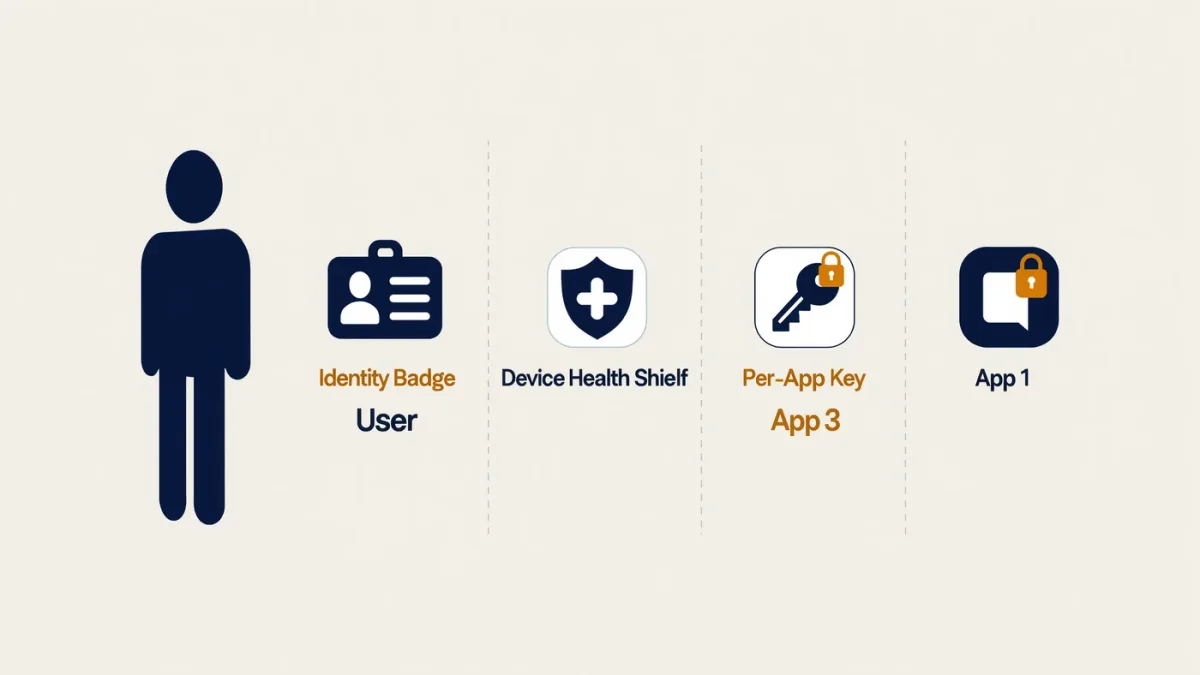
Zero trust is a security architecture that abandons the assumption that anything inside the network is trustworthy: every access request — user, device, application — is authenticated, authorized, and encrypted regardless of where it comes from, with access granted narrowly and re-verified continuously. The name comes from the founding insight of Google's BeyondCorp papers and NIST's 800-207 standard: the perimeter model, where being "inside the firewall" conferred trust, collapsed once cloud services, remote work, and phishing made inside and outside meaningless. What zero trust is not: a single product you can buy — it is a set of design principles that products serve.
Why did the perimeter model fail?
The old architecture ran on a hardened boundary and a soft interior: VPN in, then wide access to everything. Three forces broke it. Cloud moved the applications outside the wall. Remote work moved the users outside it. And attackers demonstrated — for a decade of APT campaigns — that once any single laptop inside was compromised, flat internal networks offered no further resistance, which is exactly how breaches traversed from a phished inbox to domain control. The lesson crystallized: network location is not identity. Being on the network proves nothing about who you are or whether your device is healthy.
What are the actual principles?
NIST SP 800-207 organizes them into seven tenets; the operative four: security coverage.
- Verify explicitly, every time: identity plus device posture — is it managed, patched, encrypted? — for every resource request, not just at the perimeter.
- Least privilege, narrowly granted: access decisions are per-application and per-session, scoped to what the request needs, granted just-in-time where possible.
- Assume breach: design as if the attacker is already inside — microsegmentation limits lateral movement, and continuous monitoring watches for the abuse that authentication cannot prevent.
- No implicit trust by network location: the LAN is just another untrusted network; encryption and authentication apply end to end.
How do organizations actually implement it?
As a multi-year program in phases, not a procurement:
- Identity foundation: phishing-resistant MFA everywhere, single sign-on, conditional-access policies that evaluate device health. This phase delivers most of the benefit and is the one organizations most often stop after.
- Device posture: managed, measured devices; access decisions consider patch level and enrollment state.
- Application-level access: replace network-level VPN access with per-application gateways (ZTNA — zero-trust network access), so a contractor reaches the one app they need and nothing else.
- Segmentation: internal networks divided so compromise of one segment is not compromise of all.
- Continuous monitoring and analytics: sessions evaluated for behavioral anomalies, access rights recertified on a schedule.
The U.S. federal government mandated this direction for civilian agencies by 2023-2024 OMB memo — and agencies' difficulty hitting the deadlines is itself instructive: identity-first phased adoption works; big-bang zero-trust programs stall.
What does zero trust mean at home?
More than you would expect, in translated form:
- MFA on every account is verify-explicitly for your personal identity perimeter.
- IoT isolation on a guest network is microsegmentation: nothing trusts the lightbulbs.
- Per-device encryption and unique passwords assume each device may be the breached one and limit what it reaches.
- Sign-in alerts and session revocation are continuous verification of your accounts.
- Least privilege via app permissions audits — each app gets only what its function needs.
The household version of the CISO's slide deck is the same idea at kitchen-table scale: verify everything, trust nothing by default, and make each compromise small.
What are the honest criticisms?
Three worth holding. "Zero trust" became a marketing term stretched over almost any security product, diluting a real architecture into buzzword soup — if a vendor's zero trust is a box you buy, it is not. Full implementations are hard: legacy applications resist identity-aware access, and continuous verification generates telemetry that itself becomes surveillance infrastructure with workplace-privacy implications. And verification friction lands on users — helpdesk load and lockouts are the tax that poorly-tuned programs pay. The balanced view: the principles are correct and the direction inevitable; the maturity of execution is what separates transformation from logo changes on the same old VPN.