
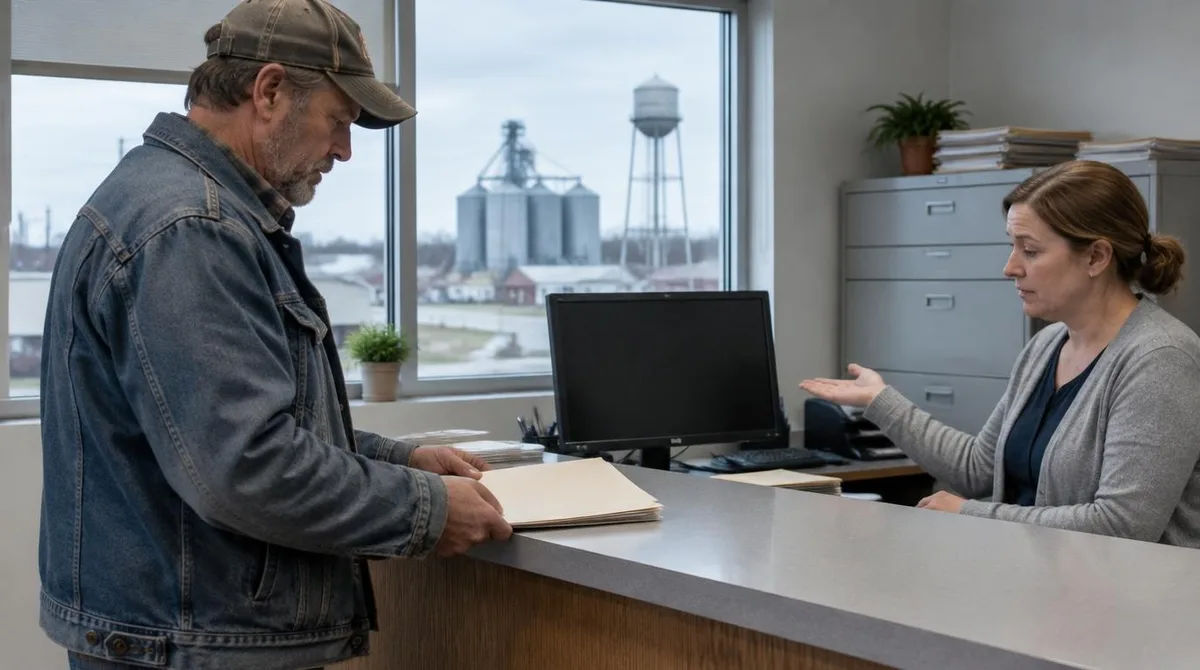
USDA shut down its systems in response to a cyber threat last week, and the department says no data was lost. That is the official account, given by Undersecretary for Farm Production and Conservation Richard Fordyce on Friday. What the department has not provided is the basis for that assessment, and for a week, Farm Service Agency (FSA) and Natural Resources Conservation Service (NRCS) employees could not perform most farmer-facing functions.
The gap between those two facts is the real story here. According to DTN Progressive Farmer, the department has not publicly explained how it concluded no personally identifiable information was lost, and there is no clarity over whether personal information was accessed or copied even if no data was lost. Fordyce also said he did not know which systems were affected or the scope of the shutdown. "I'm way over my skis when I'm talking about this," he said.
For farmers, the practical picture is mixed. On Monday, DTN reported that local FSA and NRCS office staff were told they could again perform certain computer functions related to loans and conservation programs. But the enrollment deadline for Agriculture Risk Coverage and Price Loss Coverage (ARC and PLC) stays at Dec. 11, despite at least a week without computer access. Fordyce said farmers who contacted their local office but could not complete the paperwork would get some leeway in signing up.
What did USDA actually confirm?
Three things, per Fordyce's remarks to the National Association of Farm Broadcasters as reported by DTN. First, USDA systems were shut down in response to a cyber threat. Second, "No data was lost because the system that protect against cybersecurity threats worked," in his words. Third, the department has been migrating dozens of older databases into a new single platform, and about half had been moved over before the incident.
What remains unconfirmed is just about everything a farmer would want to know: which systems were hit, whether personal information was accessed or copied, and when full payment services resume. The department has not given a comprehensive public account of the incident. "No data was lost" and "no data was accessed" are different claims, and USDA has only made the first one.
Why the silence matters more than the outage
A week of dark offices is an inconvenience with a clear fix. An unexplained data assessment is a trust problem with no clear fix. Ryan Marquardt, vice president of the Iowa Farmers Union, called on USDA to explain what happened, identify what information might have been accessed, and clarify when payment services would resume. "The lack of information is disconcerting, and it just fuels more questions about what exactly happened," Marquardt told DTN. "It tells me that the situation is probably much worse than they want to tell us."
Notably, few farm groups have publicly voiced concerns so far. The Iowa Farmers Union is one of the few. That quiet may not hold if payment services stay frozen or if a data question surfaces later. When an agency answers an incident with reassurance but no evidence, every later disclosure tends to read as a correction. This is a familiar pattern in breach communication: the organizations that recover fastest publicly are the ones that describe what they know and clearly label what they do not. Readers sorting out their own exposure after any incident can start with what to do if your email account was breached, which walks through the same order of operations. This connects to our earlier piece, What to do if your email account was breached, in the right order.
The watchdog reports behind the story
The lack of detail lands harder because of what federal auditors had already said about USDA's security posture over the past six months.
- In May, USDA's Office of Inspector General (OIG) found the department was not in compliance with federal standards related to artificial intelligence, and that cybersecurity controls had not been fully implemented and lacked critical security controls, "leaving the agency susceptible to data breaches or reputational harm." The report made three recommendations, including assessing security risks before allowing AI technologies onto USDA's network.
- In July, an OIG audit rated USDA's information security systems as "ineffective" under government criteria for protecting against cyber threats, with 10 recommendations. Detailed findings were withheld from public release because they contained sensitive security information. The OIG called for robust monitoring capabilities and a process to hold service centers accountable for compliance gaps.
- In September, the OIG's report on USDA's top management challenges again called for stronger monitoring of the department's computer systems.
- Last week, a Government Accountability Office (GAO) report identified staffing shortages and inadequate resources as obstacles to USDA's cybersecurity responsibilities for the nation's food and agriculture sector. USDA disputed the GAO's findings and recommendations.
Read together, these reports frame the incident. An agency rated "ineffective" at information security in July, with monitoring gaps flagged repeatedly, is now asking the public to accept a clean data assessment it has not explained. The two facts do not contradict each other, but they do not reassure either. The broader lesson about limiting damage when a network is compromised is the same one covered in how network segmentation limits breach blast radius — containment matters, but so does being able to prove what the attacker touched.
What this means for farm data
FSA and NRCS offices hold the paperwork of farm life: loans, conservation programs, enrollment records. When those systems go dark, the work does not stop, it queues. The Dec. 11 ARC and PLC deadline standing firm despite the outage shifts the burden onto farmers, softened only by the promised leeway for those who contacted a local office in time. Anyone who did not make contact during the outage window has no documented accommodation in the record so far.
The migration angle deserves attention too. Fordyce said about half of USDA's dozens of older databases had been moved to a new, single system. Consolidation can improve security, but it also concentrates data. If the new platform becomes the department's single store for farmer records, the stakes of any future incident rise accordingly. That is a structural trade-off worth watching as the second half of the migration proceeds.
What to watch next
Three open items will tell you where this is heading. One: whether USDA publishes a fuller account of the incident, including which systems were affected and the basis for the no-data-lost finding. Two: when payment services fully resume, and whether the ARC and PLC deadline moves if enrollment stays blocked. Three: whether more farm groups follow the Iowa Farmers Union in pressing for answers. Until any of that changes, the confirmed record is a shutdown, a partial restoration of loan and conservation functions, a firm deadline with case-by-case leeway, and an assurance the department has not yet backed with detail.