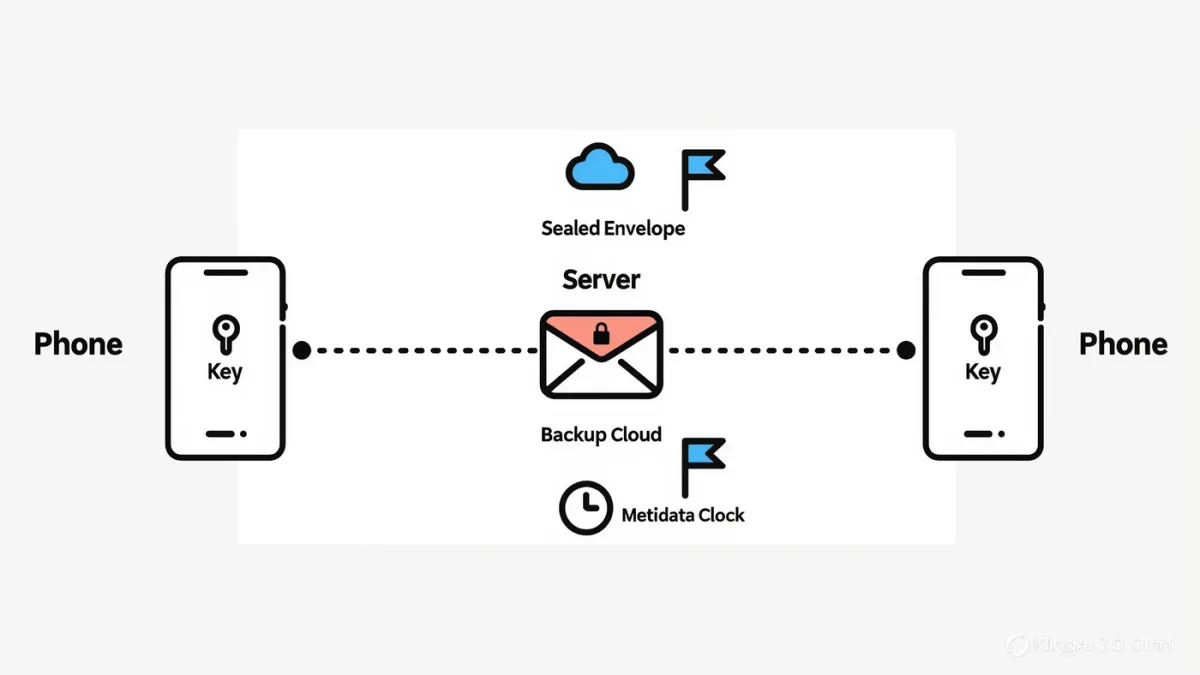
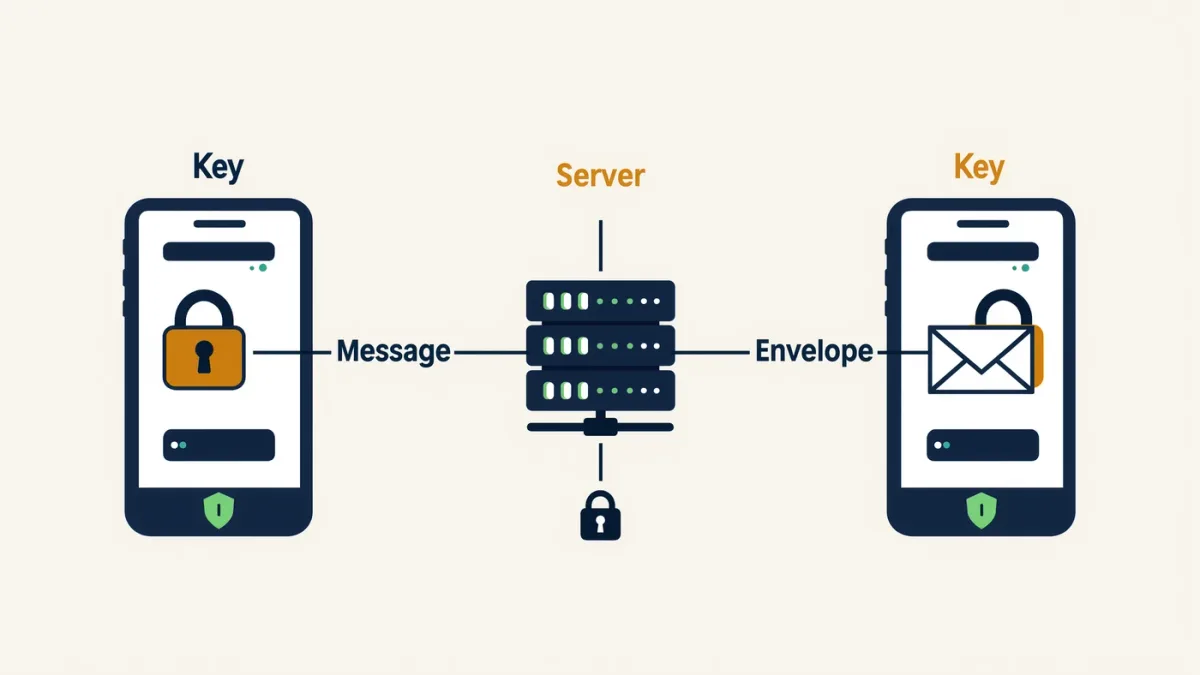
End-to-end encryption (E2EE) means a message is encrypted on your device and stays encrypted until it is decrypted on the recipient's device — so no one in the middle, including the service provider itself, can read the content. The alternative, transport encryption, protects the message only while it travels; the provider decrypts and re-encrypts it on its servers, which means the provider can read, scan, log, or be compelled to hand over what you sent. Both display the same padlock in a browser or app, which is why services that are merely transport-encrypted are routinely mistaken for end-to-end.
How does it actually work?
E2EE rests on public-key cryptography. Each device generates a key pair: a public key it shares freely and a private key it never reveals. To send you a message, the sender's device fetches your public key, encrypts the message with it, and only your private key — which exists solely on your devices — can unlock it. Modern protocols layer more on top: forward secrecy rotates keys so past messages stay unreadable even if a current key leaks, and the Signal protocol used by WhatsApp, Signal, and others verifies key changes and builds in authentication via safety numbers. The mathematics is public and among the most-studied in computer science — the practical weak points are key storage on devices and, above all, the endpoints themselves.
Which services are actually end-to-end encrypted?
As of 2025: Signal, WhatsApp, Apple iMessage and FaceTime, and Google Messages in RCS conversations with other RCS users are end-to-end encrypted by default for content. Threema and Wire offer it as well. Not end-to-end by default: standard SMS and MMS (unencrypted entirely), standard Telegram chats (cloud chats are encrypted client-to-server; only Secret Chats are E2EE), Discord, Slack, and most team-chat tools (transport-encrypted with provider access), and ordinary email between providers (transport-encrypted between servers, readable by each mail service).
The pattern to internalize: default-on E2EE protects everyone, opt-in E2EE protects only the careful. Telegram's hundreds of millions of users conduct the overwhelming majority of chats in its cloud mode, provider-accessible, because the encrypted option requires manually starting a Secret Chat.
What does E2EE not protect against?
An honest list, because overselling this technology gets people hurt:
- Compromised endpoints. If malware runs on your phone — infostealers are the common carrier — it reads messages after decryption. The strongest protocol cannot out-encrypt an infected device.
- Metadata. Who you talk to, when, how often, and from where is visible to the service even in E2EE systems. Metadata alone is investigative gold.
- Backups. WhatsApp's E2EE extends to backups only if you turn on encrypted backup; default unencrypted iCloud or Google Drive copies hand the content to the cloud account. Apple's Advanced Data Protection similarly brings iCloud storage to end-to-end encryption only when enabled.
- Screenshots, sync tools, and the person on the other end. The recipient can photograph any conversation. E2EE is trust between devices, not trust between people.
- Cloud-linked desktop mirrors. Some services bridge desktop clients through the phone; others route through servers in ways that break the end-to-end property for third-party clients.
How do you know a key really belongs to your contact?
Key verification closes the loop. Signal shows a safety number per conversation: if both parties compare it — in person, or by voice — a mismatch reveals a machine-in-the-middle. WhatsApp offers the same via QR-code scanning under contact info. Most people never verify, and for most threat models the automatic protections suffice; journalists, activists, and anyone facing a targeted adversary should treat verification as mandatory, because a man-in-the-middle insertion is precisely the attack E2EE otherwise makes impossible.
Why do governments keep fighting about it?
Because the property is absolute by design. Law-enforcement and intelligence agencies in the U.S., U.K., EU, and Australia have repeatedly pushed for client-side scanning or exceptional-access mechanisms — software on your device that scans messages before encryption or after decryption, or a key escrow arrangement. Cryptographers and the U.S. National Security Agency's own public advice on the topic have converged on the same technical critique in recent years: any access mechanism built for the good guys is a vulnerability available to the bad ones, weakening E2EE for every user simultaneously. The policy fight continued through 2025 with the U.K.'s Online Safety Act implementation hanging over messaging providers; the engineering consensus did not move.
Should you switch apps over this?
If your current default is SMS or cloud-chat, yes — moving everyday conversation to a default-E2EE app is among the cheapest security upgrades available. If you already live in WhatsApp or iMessage, the bigger wins are enabling encrypted backups, keeping devices clean, and verifying keys for the conversations that genuinely matter. The app choice sets the floor; the settings and the endpoints set the ceiling.